
I keep sleeping through my alarm
You are not sleeping through your alarm: you dismiss it in your sleep and forget. The evidence on your phone, and the four fixes ranked by effort.

The short answer
Most of the time, "sleeping through" an alarm is actually dismissing it in your sleep and forgetting. The evidence is on the phone: the alarm toggle is already off, and Screen Time shows a pickup at the minute it rang. During sleep inertia, the 15-to-60-minute impaired window after waking, the brain can run a practised motor action like swiping without ever forming a memory of it. So the fix is not a louder sound; it is a dismissal task a sleeping person physically cannot perform.
That is not a hearing problem and it is not a character problem. It is a memory problem: your brain woke up just far enough to run a well-practised motor action, and not far enough to write it down. Which means the fix is not a louder alarm. You have tried a louder alarm. The fix is making dismissal into something a sleeping person physically cannot do.
Why do I turn my alarm off in my sleep?
Lynn Trotti’s 2017 review in Sleep Medicine Reviews is the clearest summary of it: performance impairments right after waking are substantial, and in Wertz’s addition-test experiment in JAMA, performance in the first minutes after waking was worse than after 26 hours without sleep. Nobody is making good decisions in that window. But the motor system is fine. Reaching, swiping and tapping are automatic, over-learned actions, and they run beautifully on a brain that is otherwise offline. You dismiss the alarm the same way you can drive a familiar route with no memory of the last three miles.
On top of that, you habituate. If the same tone plays every morning and nothing bad happens when it is dismissed, the sound loses its salience. This is why the new alarm sound works for four days and then stops working.
And this is not a niche failure. When researchers analysed 3 million sleep sessions from more than 21,000 people for a 2025 paper in Scientific Reports, 55.6% ended in a snooze rather than a clean wake-up, and 45% of users snoozed on more than 80% of their mornings. Half-asleep hands operating alarm controls is the normal case, not the exception.
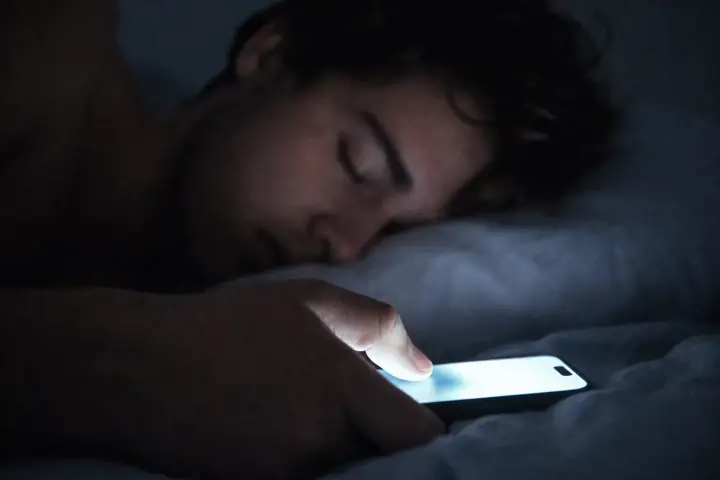
Is your iPhone making the alarm quieter?
Sometimes, yes. Rule that out before you blame yourself. On iPhone, the most common culprit is Attention Aware Features: if the TrueDepth camera sees that you are looking at the phone, iOS lowers the volume of your alerts, alarm included; Apple documents the behaviour. Half-open eyes count. Turn it off in Settings → Face ID & Passcode. There are six more of these, and we listed all of them in iPhone alarm not going off. If the alarm rings but sounds like it is coming from another room, the settings that actually govern volume are in the loudest alarm sound on iPhone.
How do I stop sleeping through my alarm?
In one sentence: go to bed earlier if you can, and if you cannot, make dismissal into a task; those are the only two fixes in the table below that survive a genuinely bad night.
| Fix | Effort | Does it survive a bad night? |
|---|---|---|
| Phone across the room | Free, tonight | Sometimes. You will learn to turn it off and walk back. |
| Turn off the snooze toggle in the Clock app | Free, ten seconds | Sometimes. Nothing stops you dismissing it. |
| Go to bed 45 minutes earlier | Hard, but it is the real fix | Yes. Every other item on this list is a workaround for this one. |
| An alarm you have to complete a mission to stop | Paid app | Yes. You cannot scan a coffee machine in your sleep. |
Take the third row seriously. The CDC reported in MMWR (2016) that only 65.2% of US adults reach the recommended seven hours a night; more than one in three run short. If you are one of them, the alarm is not the problem: the alarm is going off during the sleep you should already have had. An app cannot manufacture sleep you did not take.
Find the bedtime that fixes row three
Enter your wake-up time and the calculator works backwards through full sleep cycles, and flags the bedtimes that get you seven hours or more.
To wake up at 07:00, go to bed at:
- 21:457.5–9 hours
- 23:157.5–9 hours
- 00:45
- 02:15
Fifteen minutes is the standard default, not a fact about you. Set it to what your nights actually look like and every time above moves with it.
Prove it to yourself first
You do not have to take our word for any of this. Tomorrow morning, when you wake up late and furious, open the Clock app before you open anything else and look at whether the alarm is still armed for tomorrow or whether it was dismissed. Check Screen Time for a pickup at 06:40. Nine times out of ten the evidence is right there: you interacted with the phone, at the correct time, and you have no memory of the interaction.
That distinction matters because it decides which fix you need. If the alarm genuinely never rang, this is a settings problem and the fixes are in iPhone alarm not going off. If the alarm rang and you killed it, no setting on earth helps you, because nothing was broken except the assumption that the person holding the phone at 6:40am is you.
A made-up but typical case: Marcus, 31, runs the early shift at a Leeds warehouse and has to be out of the door at 5:40am. Two alarms, 5:00 and 5:10, phone on the nightstand. Twice a month he "sleeps through both", except Screen Time shows a pickup at 5:00, seconds after the first alarm, every single time. He moved the phone to the hallway and learned to walk there and back without waking. What finally held was making the second alarm a scan mission on the kettle: you can walk in your sleep, but you cannot aim a camera in your sleep.
Why an obstacle works when a noise does not
A noise asks your brain to make a decision. An obstacle asks your body to perform a sequence, and a sequence cannot be run in your sleep because it requires feedback: you have to look at something, aim at something, get it right. That is the entire design principle behind Risly. There is no snooze button and no dismiss button. The alarm stops when you complete a mission: a live camera scan of an object across the house, chained math problems, a sustained shake, or push-ups counted by the front camera.
The scan is the one that works best for people who dismiss alarms in their sleep, because it does not just demand attention: it demands relocation. Register the coffee machine. You cannot photograph the coffee machine from bed, and once you are standing at the coffee machine at 6:41am with a siren in your hand, the morning has effectively started without your permission.
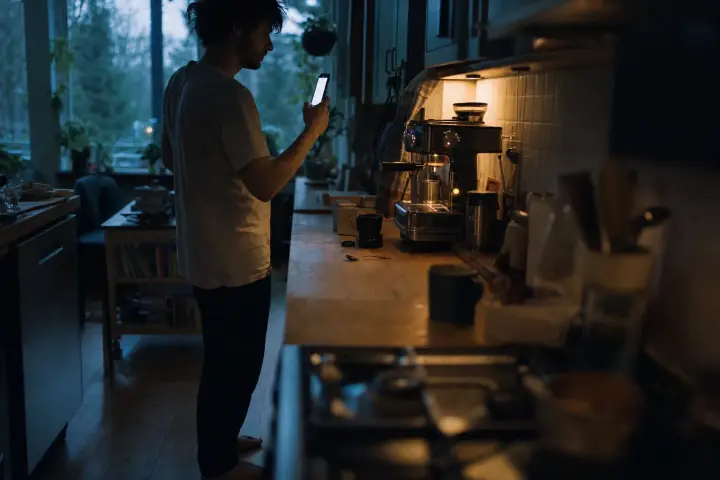
And because Risly is built on Apple’s AlarmKit (iOS 26+), the alarm fires like the system one: through silent mode, through Focus, through Do Not Disturb, and even if you force-quit the app. That is not true of most alarm apps, which is why so many of them ask you to reconfigure your phone before you trust them.
When this is not a discipline problem at all
If you sleep nine hours and still cannot wake, if you are exhausted every single day, if you snore heavily or wake with headaches, stop reading marketing pages and talk to a doctor. Sleep apnea, narcolepsy, thyroid problems and depression all present exactly like "I cannot hear my alarm", and none of them is fixed by an app that shouts at you. If the pattern is lifelong difficulty starting anything in the morning rather than not hearing the noise, the mechanism is different again and we cover it in alarms for ADHD. We would rather lose the sale than have you spend a year blaming your willpower for something clinical.
Fair questions
Why do I turn off my alarm in my sleep and not remember?
Because dismissing an alarm is a short, over-learned motor action that your brain can execute during sleep inertia without forming a memory. The action happens; the memory does not. Checking your phone usually shows the alarm was dismissed, not missed.
Does putting my phone across the room work?
Partly, and it is free, so do it tonight. The failure mode is that you learn to walk over, dismiss it, and get back into bed, still with no memory of it. It works far better combined with an alarm that requires a task.
Why does a new alarm sound stop working after a few days?
Habituation. A sound that has never had a consequence loses its salience, and your brain stops treating it as a signal worth waking for. This is why alarm apps that rotate sounds help a little and alarm apps that require an action help a lot.
Should I set multiple alarms?
No. Multiple alarms teach you that the first alarm is not the real one, and once you have learned that, you sleep through all of them. Set one alarm, for the time you actually have to be up.
When should I see a doctor about this?
If you sleep a full night and still cannot wake, if you are tired every day regardless of sleep, or if you snore heavily and wake with headaches. Sleep apnea and narcolepsy present exactly like this and no alarm app treats them.
Sources
- Trotti, 2017. Sleep Medicine Reviews: "Waking up is the hardest thing I do all day" (sleep inertia review)
- Wertz et al., 2006. JAMA: cognitive performance in the first minutes after waking
- Hilditch & McHill, 2019. Nature and Science of Sleep: sleep inertia duration and mechanisms
- Robbins et al., 2025. Scientific Reports: snooze behaviour across 3 million sleep sessions
- Liu et al., 2016. CDC MMWR: prevalence of healthy sleep duration among US adults
- Apple Support: Attention Aware Features lower alert volume when you look at the device
Keep reading




Ready when you are
Choose your next wake-up mission.