
The alarm that makes you do push-ups
A push-up alarm rings until the front camera has counted your reps. How the counting works, how many to set, and what the evidence actually supports.

The short answer
A push-up alarm keeps ringing until your phone’s front camera has counted the reps you set: in Risly anywhere from three to ten, and eight to ten is the setting that ends the argument for most people (that band is our practical read from using it, not a figure anyone has measured), because nobody performs a push-up while asleep. What it will not do is cure the grogginess: Christopher Hilditch and Andrew McHill’s 2019 review in Nature and Science of Sleep found the evidence thin for every sleep-inertia countermeasure, physical activity included, so the mission is a lock on the snooze, not a treatment for the 15 to 60 minutes of fog that follow waking.
Every other dismissal task can be completed horizontally. You can tap in your sleep, swipe in your sleep, and people solve puzzles half-conscious and remember none of it. A push-up is the one task that cannot be done in bed, and that single physical fact is the entire design: by the time rep one is finished your hands are on the floor, your ribs are off the mattress, and the negotiation you normally lose at 6:40am never gets to start.
In Risly it is one of nine missions (mental math, a memory game, a shape you draw with your finger, a kiss, an object scan, a QR code scan, a product scan, shaking the phone, and push-ups), and the full set lives on the missions page. None of them has a snooze button behind it, because the app does not contain one. This page is about the push-up one: how the phone counts, how many reps are worth setting, what the research does and does not support, and when you should pick something else.
What is a push-up alarm and how does it work?
Mechanically it is almost boringly simple. You put the phone on the floor with the front camera pointing up at you (flat on its back, screen up, exactly as the app words it), get into position over it, and start. The alarm keeps going the entire time. Every completed rep advances a counter on screen, short prompts appear when the camera loses you (Get in frame, Get into push-up position, Go down, Push up), and the noise ends on the rep that hits your target. Not before, and not for anything else.
The detail that decides whether a mission like this survives contact with a real morning is what happens when it goes wrong. A camera that cannot see you must never become a free dismiss, and it must never become a trap either. In Risly, if the room is too dark or the framing is hopeless, a link appears after 90 seconds offering the math mission instead. A link, not an exit: it swaps one gate for another and the alarm carries on ringing until you clear it. Deny the camera permission outright and you get the same treatment. There is no state in which the phone gives up and goes quiet on its own.
How does a phone count push-ups?
By watching your shoulders, not your face. The front camera feeds Apple’s on-device body-pose detection, which returns your joint positions frame by frame, and because the lens is pointing straight up at you the only signal worth reading is vertical: seen head-on, the angle at your elbows is flattened by foreshortening and says almost nothing, while the line of your shoulders drops and climbs by an amount the phone can measure. Risly smooths that height, keeps the highest position you have held over the last few seconds as the top of your range, and counts one rep every time the shoulders sink far enough below that top and come back up to it. A dip that stays shallow is a half rep and does not count; a minimum gap between counted reps stops a bounce from registering as a set; and a cycle that drags on too long is thrown away rather than banked: you paused, so the counter re-arms and waits for the next real one.
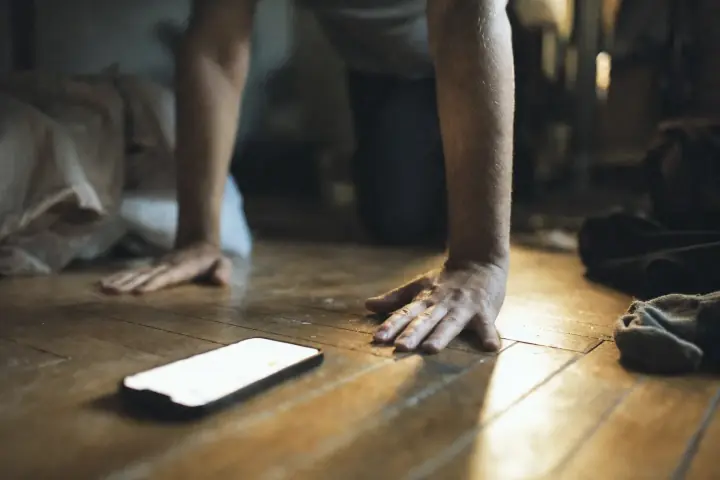
On privacy, the scope matters more than the slogan, so here is the precise version for this mission: the pose detection runs on the device, no frame is uploaded, and no photo or video of you is written to disk. The only thing the mission leaves behind is a number, the reps you did, which turns up in your own stats. That is a claim about the push-up mission specifically, not a blanket statement about every camera feature in every alarm app, and it is worth demanding in writing from anything that asks to point a lens at your bedroom floor at 6am.
What it is not is a fitness tracker. It does not grade your depth, correct your form, or log a workout. It counts well enough to know the work happened, and it stops the alarm. It is a lock; your body is the key.
How many push-ups should you set on your alarm?
Eight to ten, for almost everybody. Risly’s stepper runs from three to ten with a default of five, and the useful range sits at the top of it: enough reps that you are breathing hard and unmistakably awake, few enough that the mission is over in under a minute and you never start dreading bedtime.
| Reps you can set | What it feels like at 6:40am (our view, not a measurement) | Our verdict |
|---|---|---|
| 3 | Over before you have registered it. This is the floor: the stepper goes no lower. | Too few for most people. Doable in a fog, and your bed is still one step away. |
| 8–10 | Awake somewhere around rep six, breathing hard by rep ten. | Our recommendation. Ten is the ceiling in Risly, and it is enough. |
| 20+ | Not available; the count stops at ten. | Deliberately capped. Ambition chosen at 11pm is not a plan, and a mission you resent is a mission you delete. |
The failure mode is never laziness, it is enthusiasm. People install a mission alarm on a Sunday evening full of resolve, set a number that belongs in a training log, hate their lives by Thursday and uninstall on Friday. The ceiling of ten exists to make that mistake unavailable. Eight reps put you on the floor and out of breath, which is the whole mechanism; everything above that is vanity paying rent in your morning.
Does doing push-ups actually wake you up?
It gets you out of bed, and that part is not in dispute. Whether it shortens the grogginess itself is a different claim, and the honest answer is that nobody has demonstrated it. Hilditch and McHill went looking for the evidence behind every popular sleep-inertia countermeasure (caffeine, light, sound, physical activity) in Nature and Science of Sleep (2019), and found the base thin across the board. No published trial has put a push-up alarm against an ordinary one. Anyone selling exercise as a proven cure for morning fog is ahead of the data, and that includes anyone selling you this app.
It helps to know what is actually being fought. The impairment has a name and a shape: sleep inertia, the degraded state that follows waking, at its worst in the first minutes and running 15 to 60 minutes for most people. Its extreme end has its own name too: sleep drunkenness, the confusional arousals reviewed by Lynn Trotti in Sleep Medicine Reviews (2017), reported by roughly one adult in seven in the population data she cites. Nothing you do in the first sixty seconds abolishes any of that.
What survives the honesty is narrower and still worth having. You cannot do eight push-ups while asleep. The mission takes real time, demands sustained effort, cannot be run on autopilot, and ends with you upright in the middle of the room with your heart rate raised. Compare that with the alternative everyone reaches for: caffeine peaks in the blood anywhere from 15 to 120 minutes after you drink it (Antonio et al., 2024), a spread so wide that you cannot know whether this particular cup lands in a quarter of an hour or in two. That is what disqualifies coffee as the plan: it arrives at some point, and the decision you keep losing is not at some point, it is now. The push-ups happen inside the window, every time.
What does a push-up alarm actually feel like at 6:40am?
An illustrative case, not a study participant. Nadia is 29 and opens a bakery in Cardiff at six, which means a 4:50 alarm she had been losing to for a year. Her first week on push-ups, set to eight, she reports the same shape every morning: rep one is an outrage, rep two is somehow worse, and then around rep five the noise stops being an emergency and turns into something she is simply working through. By rep eight she is annoyed rather than desperate, and being properly annoyed is a fully awake emotion. Nobody in the middle of sleep inertia has the resources to hold a grudge.
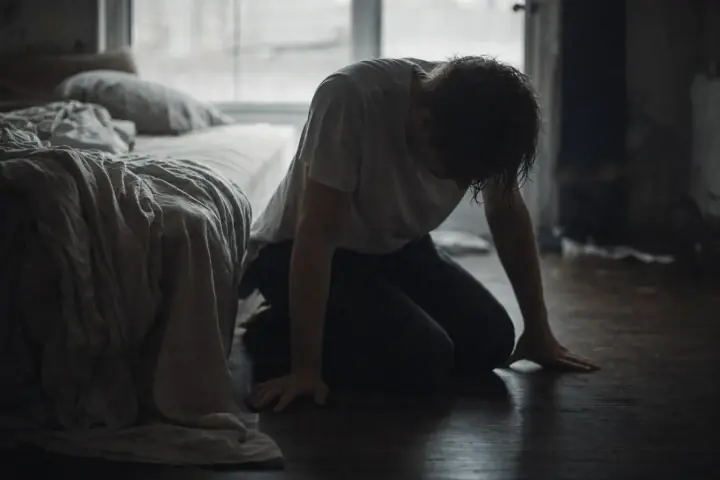
Then it goes quiet, and she is standing in the middle of the room at 4:52, warm and breathing hard. There is no version of that scene that ends back under the duvet. Set it beside the standard morning (horizontal, warm, in the dark, one thumb between you and silence), and the difference is not psychological cleverness. The mission changed the position of her body, and the position of your body is most of the argument about whether you are getting up.
When should you pick a different mission instead?
More often than a page named after push-ups should probably admit. Match the mission to your failure mode rather than to our marketing: four cases where this is the wrong one.
- Any shoulder, wrist or back problem. Do not negotiate with an alarm app about this. Use the camera scan on an object in another room instead.
- A shared bedroom. Push-ups next to a sleeping partner at 6:40am is a relationship event, not a mission.
- A small or dark room. The camera has to see your whole body, and a dark bedroom is the single most common reason the counter stalls. If there is no clear floor and no light you can switch on first, pick a mission that does not need eyes.
- If your real problem is dismissing the alarm with no memory of it, push-ups alone may not be enough, because you are still within reach of the bed. Distance is the answer there, and a scan in another room enforces distance in a way that reps on the bedroom floor do not.
There is one problem no mission on any app can fix, and it is worth naming before you buy anything: if you go to bed at 1am and set the alarm for 5:30, eight push-ups will get you vertical but they will not buy back the missing hours, and the fog you are fighting scales with the deficit behind it. Pick the wake-up time you actually need, then work backwards to the bedtime that pays for it.
What time should you go to bed for that alarm?
Enter the hour you have to be up and the calculator counts back in full 90-minute cycles to the bedtimes that fit it. The mission decides whether you get off the mattress; the bedtime decides what that costs you.
To wake up at 07:00, go to bed at:
- 21:457.5–9 hours
- 23:157.5–9 hours
- 00:45
- 02:15
Fifteen minutes is the standard default, not a fact about you. Set it to what your nights actually look like and every time above moves with it.
Does the push-up alarm ring through silent mode and Focus?
Yes, and this is the part that has to work before any mission means anything. Apple documents the behaviour for iPhone alarms plainly: Do Not Disturb, the Ring/Silent switch and Silent mode do not affect the alarm sound. Risly schedules its alarms through AlarmKit, Apple’s iOS 26 alarm framework, so they are owned by the system exactly like the Clock app’s and fire even if the app has been force-quit. Focus is not named on that Apple page, so we will label it for what it is: in our own testing a Focus does not silence these alarms either, which is our field finding rather than a documented Apple guarantee.
That distinction is the whole reason older alarm apps ask you to turn off silent mode and add them to an allow-list before you trust them: they ring as notifications, and a notification is something iOS is permitted to swallow. It is also why Alarmy, the biggest app in this category at 100 million cumulative downloads by its publisher’s own figures, ships a comparable exercise mission (squats, on its paid Alarmy Pro tier) on Android as well as iPhone, while Risly deliberately runs nowhere but iOS 26 and later.
And the caveat we put on every page: this app is deliberately unpleasant. If you want to be eased into the day, a sunrise lamp will treat you better. If you want to be on the floor eleven seconds after the alarm goes off, with no snooze button anywhere in the app to argue with, the reasoning is on the anti-snooze page.
Alarm that makes you do push-ups: common questions
What is the alarm app that makes you do push-ups?
Risly. The front camera counts your reps and the alarm does not stop until you hit the target you set, anywhere from three to ten; there is no snooze button in the app. It requires iOS 26 or later. Alarmy has a squats mission built on a similar principle and also runs on Android, though that mission sits behind its paid Alarmy Pro tier; we put the two side by side in our Alarmy comparison.
How does a phone count push-ups without a wearable?
It uses the front camera and Apple’s on-device body-pose detection. With the phone on the floor looking up at you, Risly tracks the height of your shoulders frame by frame rather than the angle at your elbows, which foreshortening makes useless head-on. It holds the highest position of the last few seconds as the top of your range and counts one rep each time your shoulders sink well below it and return, with a minimum gap between counted reps so a wobble cannot be mistaken for a push-up.
Is five push-ups enough to wake you up?
Five is the default and it works, but our view, not a measurement, is that eight to ten is the better setting: five can be cleared before you have properly registered doing it. Ten is the maximum Risly allows, on purpose, because the reps people choose at bedtime are the reason mission alarms get uninstalled in week two.
Do push-ups cure morning grogginess?
Not as far as anyone has shown. Hilditch and McHill’s 2019 review in Nature and Science of Sleep found the evidence thin for every sleep-inertia countermeasure, exercise included, and no study has compared a push-up alarm with an ordinary one. What the mission verifiably does is make dismissal impossible to perform in your sleep.
What if I can’t do push-ups?
Pick one of the other six missions. Risly also offers mental math, a memory game, an object scan, a QR code scan, a product scan and shaking the phone; the scans are the better choice if you have a shoulder or wrist problem, or if you share a bedroom.
What happens if the camera cannot see me?
Nothing that ends the alarm. Prompts tell you to get back in frame or into position, and after 90 seconds a link appears offering the math mission instead. Denying the camera permission routes you to math too. The alarm keeps ringing through all of it: a failed camera swaps the gate, it never removes it.
Sources
- Hilditch & McHill (2019). Sleep inertia: current insights (thin evidence base across countermeasures). Nature and Science of Sleep
- Trotti (2017). Waking up is the hardest thing I do all day: sleep inertia and sleep drunkenness. Sleep Medicine Reviews
- Antonio et al. (2024). Journal of the International Society of Sports Nutrition (caffeine peaks in plasma anywhere from 15 to 120 minutes after ingestion)
- Apple Support: How to set and change alarms on your iPhone (Do Not Disturb, the Ring/Silent switch and Silent mode do not affect the alarm sound)
- Delightroom: official company figures for Alarmy (100 million cumulative downloads)
Keep reading




Ready when you are
Choose your next wake-up mission.