
What is sleep inertia?
Sleep inertia is the impaired, slow-thinking state right after waking. It usually lasts 15 to 60 minutes and hits hardest out of deep sleep.
The short answer
Sleep inertia is the foggy, slow, clumsy state you are in for the first stretch after waking. It usually lasts 15 to 60 minutes, it is worst when an alarm pulls you out of deep sleep, and while you are in it your attention, reaction time and judgement are measurably worse than normal.
Every health site will tell you that much. Here is the part almost none of them reach. Sleep inertia peaks in the first few minutes after waking, and those are the minutes when your alarm hands you a decision. Off, or nine more. That decision gets made by the least capable version of you there is.
The definition, in one paragraph
The term is not new. Patricia Tassi and Alain Muzet wrote the reference review in Sleep Medicine Reviews in 2000 and described the pattern researchers still describe today: performance drops sharply at the moment of waking, then climbs back, and the severity depends on your sleep debt and which stage you were pulled out of.
Sleep inertia symptoms are boring and universal. Grogginess. Clumsiness. Not knowing what day it is. Reading the same sentence three times. Putting the kettle on with no memory of it. Its extreme form, described by Lynn Trotti in her 2017 review in Sleep Medicine Reviews, is called sleep drunkenness, and it looks the way the name suggests.
How bad is sleep inertia? Worse than sleep deprivation
This is where the research gets uncomfortable. Wertz and colleagues, in JAMA in 2006, tested people on a simple addition task right after they woke, then tested the same people after 26 hours without sleep. Performance in the first minutes after waking was worse than the sleep-deprived condition. Not a bit tired. Worse than having been awake all night and all the next day.
The recovery curve is steep first, then long and flat. Jewett and colleagues, in the Journal of Sleep Research in 1999, tracked alertness after waking and found most of the improvement lands in the first half hour, with the curve not fully levelling off for two to four hours. The crushing part of sleep inertia is short. The mediocre part is not.
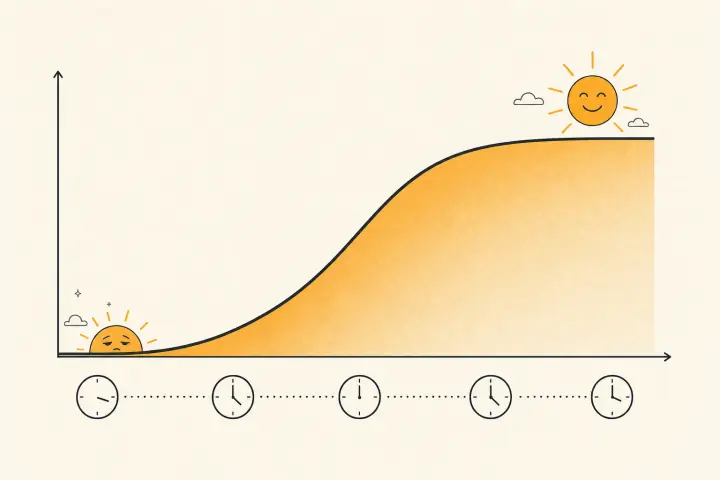
How long does sleep inertia last, hour by hour?
| Time after waking | What is going on | What you should not be doing |
|---|---|---|
| 0–5 minutes | Peak impairment. Worst judgement of your whole day | Deciding whether getting up is optional |
| 5–30 minutes | Steepest recovery. Grogginess lifting, coordination returning | Driving, if you can avoid it |
| 30–60 minutes | Most people feel normal. Reaction time still slightly off | Anything you would not do after two drinks |
| 1–4 hours | Residual effects measurable in a lab, not by you | Nothing. You are fine |
Three things make it worse, and only one is under your control at 6:40am. Sleep debt deepens it (you can add up the sleep debt you are carrying in about a minute), which is why the alarm feels violent on a five-hour night and survivable on an eight-hour one. Waking out of slow-wave sleep deepens it, which is mostly luck. An abrupt awakening deepens it, the price of owning an alarm clock.
The part the health articles leave out
Your alarm is a decision engine. It rings and hands you a choice with two buttons on it, inside the 0–5 minute window in the table above, when your judgement is at its measured worst all day. Nobody in that window weighs their 9am against forty more minutes of sleep. They press whatever stops the noise, because that is the only goal a brain in that state can hold.
The scale of that lost decision finally has numbers. In 2025, researchers at Mass General Brigham analysed three million nights of Sleep Cycle data from 21,000 people: 55.6% of all sleep sessions ended with the snooze button, the average morning burned 11 minutes between snoozes, and the heaviest 45% of users snoozed on more than 80% of their mornings. This is not a bad-habit minority. It is most people, most mornings, losing the same five-minute argument.
Which is why so many people turn an alarm off with no memory of doing it. The motor system comes back online long before the parts of you that form memories. Reaching, swiping and tapping run fine on a brain that is otherwise offline, the same way you can drive a familiar route and remember none of it. The diagnostic is in I keep sleeping through my alarm: work out whether the alarm was dismissed or missed, because the fixes differ.
Read ten pages about sleep inertia and they end the same way. Drink water, get sunlight, do not schedule hard work first thing. Sensible, and beside the point: they describe the state and stop there.
How to reduce sleep inertia: what works and what is folklore
Countermeasures have been studied properly, mostly by people who care about shift workers and pilots waking from cockpit naps. Hilditch and McHill reviewed the evidence in Nature and Science of Sleep in 2019. Some things help modestly, nothing abolishes it, and the effects are smaller than the wellness internet implies.
| Countermeasure | Does it help? | The catch |
|---|---|---|
| Bright light on waking | Modest, reasonably supported | It has to be bright. A phone screen is not light therapy |
| Caffeine | Yes, but not straight away | It takes 20–30 minutes, so the worst window has already passed |
| Getting vertical and moving | Yes, one of the more reliable ones | You have to be out of bed already, the actual problem |
| A cold shower | Anecdotally strong, thin evidence | Same catch. It comes after the decision you failed to make |
| Sleeping longer overall | The most effective single lever | It is a bedtime change, not a morning one |
| A louder alarm | No | Volume wakes you. It does not make the woken you competent |
Read down that last column and the pattern is hard to miss. Every real countermeasure needs you upright and already doing something. None work during the five minutes that decide your morning. That gap is where mornings get lost, and no amount of information closes it.
So build the morning for a person who is not thinking
The design principle is simple. Do not give the 6:40am version of you any choices. Remove them the night before, while you are competent.
Concretely: one reader we spoke to, a 26-year-old nurse on rotating shifts, used to stack nine alarms from 5:30 to 6:42, and slept through the first eight, because eight of them had taught her they were negotiable. She now sets one alarm, for 6:10, with the phone across the room. Not because she found willpower. Because the 6:10 version of her was never going to win an argument, so the 11pm version stopped scheduling one.
- Set one alarm, for the time you actually have to be up. Several alarms teach you the first is not real, and then you sleep through all of them.
- Turn the snooze toggle off in the Clock app. Ten seconds, tonight. It removes one of the two buttons.
- Put the phone where you have to stand up to reach it. Standing works, and this is the cheapest way to force it.
- Lay out clothes and keys the night before. Every decision you pre-make is one your worst self cannot fumble.
- Go to bed 45 minutes earlier. Sleep debt amplifies everything above, and this is the only item that reduces the inertia itself. If you want a concrete target, work out your bedtime for tonight with our sleep calculator.
Work out tonight’s bedtime
Sleep debt is the one lever that reduces the inertia itself, and it is decided tonight, not tomorrow morning. Pick your wake-up time: the calculator counts back in full 90-minute cycles.
To wake up at 07:00, go to bed at:
- 21:457.5–9 hours
- 23:157.5–9 hours
- 00:45
- 02:15
Fifteen minutes is the standard default, not a fact about you. Set it to what your nights actually look like and every time above moves with it.
The longer habit version is in how to stop hitting snooze. If you would rather buy a mechanism than build a habit, we ranked them in alarms that actually make you get out of bed.
Where Risly fits, and where it does not
Risly is an alarm with no snooze button and no dismiss button anywhere in it. It stops when you finish a mission: a camera scan of an object you registered somewhere in the house, chained math problems, a sustained shake, or push-ups counted by the front camera. A mission never asks a foggy brain for a judgement call. It asks your body to run a short sequence you cannot run asleep, because you have to look at something and get it right.
It is built on AlarmKit, the framework Apple shipped in iOS 26, so unlike other alarm apps it rings the way the system Clock app does: through silent mode, through Focus, even if you force-quit it the night before. Alarmy’s own support pages ask users to switch off silent mode and Do Not Disturb.
We should be straight about who this is wrong for. Risly is iOS 26 and later only, so there is no Android version. It is adversarial by design, and if you want to wake up gently, a sunrise lamp or Sleep Cycle’s smart wake window is the better buy. It also does nothing about the cause: if you are short on sleep, an app that makes you do math at 6:40am is a patch over a problem you fix at 11pm.
Removing snooze is not a health claim. The 2024 Journal of Sleep Research experiment (31 habitual snoozers, two mornings each under polysomnography) found half an hour of snoozing costs about six minutes of sleep and leaves no measurable cognitive harm, which we covered in is snoozing actually bad for you. Snoozing is a reliability problem. It can delay getting up, and we removed the button because nobody should be handed that decision while their judgement is at its daily minimum.
When it is not sleep inertia
Sleep inertia is normal, it happens to everyone, and it ends. If yours does not, that is a different conversation and not one to have with an app. Grogginess that lasts hours every day, exhaustion no matter how long you slept, heavy snoring, or falling asleep at your desk are worth taking to a doctor. Sleep apnea, narcolepsy and depression can all present as "I cannot wake up", and an alarm clock does nothing for any of them. Severe morning confusion is not rare, either: in Ohayon’s population studies, cited in Trotti’s 2017 review, about one adult in seven reported a confusional arousal in the previous year. We would rather lose the sale than have you blame your willpower for something clinical.
Fair questions
How long does sleep inertia last?
For most people 15 to 60 minutes. The worst impairment is in the first few minutes, and the steepest recovery happens over the following half hour. Jewett and colleagues (Journal of Sleep Research, 1999) found it does not fully level off for two to four hours.
Why am I so groggy when I wake up?
Because your brain does not switch on all at once. Motor function comes back quickly while attention, memory and judgement lag behind, and the lag is longer if you are short on sleep or were woken out of deep sleep.
Is sleep inertia worse if you snooze?
Not clearly. In the 2024 Journal of Sleep Research lab study, the 31 habitual snoozers who snoozed for half an hour lost about six minutes of sleep and showed no measurable cognitive impairment on the tests that followed. What it does is hand you the same decision again and again while you are impaired, which may delay getting up.
How do I get rid of sleep inertia fast?
Get vertical, get into bright light, and have caffeine early knowing it needs twenty to thirty minutes to work. None of these abolish it. The only thing that reduces the severity is arriving at the morning with less sleep debt.
Is sleep inertia the same as sleep drunkenness?
Sleep drunkenness is the severe end of the same thing: prolonged confusion and disorientation on waking, sometimes lasting well beyond an hour. Lynn Trotti describes it in her 2017 Sleep Medicine Reviews paper. If that is your mornings, get a medical opinion.
Studies cited
- Tassi & Muzet (2000). Sleep inertia. Sleep Medicine Reviews
- Jewett et al. (1999). Time course of sleep inertia dissipation in human performance and alertness. Journal of Sleep Research
- Wertz et al. (2006). Effects of sleep inertia on cognition. JAMA
- Trotti (2017). Waking up is the hardest thing I do all day: sleep inertia and sleep drunkenness. Sleep Medicine Reviews
- Hilditch & McHill (2019). Sleep inertia: current insights. Nature and Science of Sleep
- Sundelin et al. (2024). Is snoozing losing? Journal of Sleep Research
- Robbins et al. (2025). Snooze alarm use in a global population of smartphone users. Scientific Reports
Keep reading



Ready when you are
Choose your next wake-up mission.