
Why am I so tired in the morning? Your weekend might be the reason
US adults wake about 1 hour later on free days but go to bed only 23 minutes later (NHANES). That weekend shift, social jet lag, is why weekday mornings hurt.

The short answer
If you’re tired on weekday mornings but fine by lunch, a common and overlooked cause is social jet lag: in a survey of 9,004 US adults (NHANES 2017–2020), people woke a full hour later on free days but went to bed only 23 minutes later, and 46.5% had an hour or more of social jet lag. The weekend lie-in drags your body clock later, so the weekday alarm rings while your body still thinks it’s night.
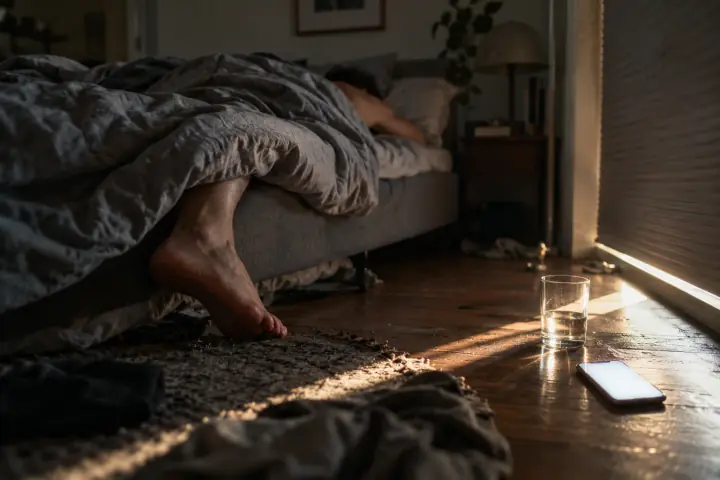
Monday, 6:41 a.m. The alarm goes off in a dark room, and the phone is the brightest thing in it. That’s not a random time. It’s the average American workday wake time, straight out of a federal health survey.
Two days ago you woke at 7:41 with no alarm at all, and felt fine. Now your body acts as if it’s an hour earlier than the clock says, like you flew east over the weekend and nobody told you.
You probably didn’t sleep badly. You slept on Saturday’s schedule, and Monday doesn’t run on it.
Why am I so tired in the morning? Look at your weekend
For a lot of people, it’s because the weekday alarm and the weekend wake-up are an hour apart. In 2022, a team writing in JAMA Network Open went through NHANES, the national health survey, for 9,004 adults aged 20 and over. Each one reported when they fell asleep and woke up, on workdays and on free days. Here’s the average American:
| Workdays | Free days | Gap | |
|---|---|---|---|
| Fall asleep | 11:02 p.m. | 11:25 p.m. | 23 minutes |
| Wake up | 6:41 a.m. | 7:41 a.m. | 1 hour |
| Sleep | 7.59 hours | 8.24 hours | About 39 minutes |
Bedtime moves 23 minutes; the alarm moves an hour. More than a quarter, 27.2%, said they felt overly sleepy five or more times a month. That’s what people reported, so it shows how common the pattern is, not that it causes the sleepiness.
So Monday’s exhaustion isn’t made on Sunday night. It’s made on Saturday morning.
Does sleeping in on weekends make up for lost sleep?
Less than it feels like, and it moves your clock the wrong way. Picture Sunday, 11:30 a.m., blinds still down. One poster in an r/work thread sleeps in “every Sunday on purpose,” 10 to 12 hours, after 6 to 7 a night all week. It feels like paying off a debt.
A 2019 lab study at the University of Colorado Boulder tested that (Current Biology). Volunteers lived in the lab for the whole schedule. Fourteen of them got five nights of 5 hours in bed, then a weekend to sleep as much as they wanted, then more short nights.
Across the whole free weekend, they slept only about 1.1 hours more than at baseline, and their body clocks came out of it running later. The study was about metabolism, not about Monday mood. But both halves of the problem are there: the lie-in repays little, and it shifts you late.
Why am I tired in the morning but awake at night?
Because a body clock running late does both jobs at once: it holds sleep back at your weekday bedtime, and it keeps you in its night when the alarm rings. That’s our reading, and it’s what people describe.
Wednesday, 10:45 p.m. All day you thought, in the words of one Redditor, “Tonight I’ll fall asleep immediately.” Then the dishes are done, the TV is off, and as someone on r/sleep puts it, “the second I lie down… my body feels alert.”
The morning half got measured in 2008 at Brigham and Women’s Hospital (Journal of Biological Rhythms). Twelve adults, average age 24, lived on 28-hour days, so their wake-ups slowly rolled around their whole body clock. After each one, they spent two minutes adding numbers. Woken during their biological night, their scores dropped 3.6 times more than when woken during their biological day.
Young volunteers, in a lab; that a late Saturday drags a 6:41 alarm toward that biological night is our inference. The fog of the first few minutes is a different thing, sleep inertia.
Why do I wake up tired after 8 hours of sleep?
Often because it wasn’t 8 hours. Time in bed isn’t time asleep, and most of us guess generously.
In a University of Chicago study, 669 middle-aged adults wore a wrist monitor for three nights, twice, and also said how long they usually sleep (Epidemiology, 2008). Their answers said 6.8 hours. The wrists said 6.0. People sleeping 5 hours overestimated by 1.2 hours; those sleeping 7, by 0.4. That’s one group in Chicago in the mid-2000s, not a law for everyone, but it’s a reason to doubt your 8. The sleep debt calculator below adds up the week you really had.
And short sleep stops feeling short. In a lab study we covered in the 5 a.m. guide, people on 6 hours a night barely noticed how far their performance had fallen. Dr. Sonja Schuetz, a sleep neurologist at University of Michigan Health, told TIME how a lot of people describe it: “It doesn’t matter how long I sleep. I wake up and feel like a truck ran over me.”
Add up your real week
Enter what you actually slept each night, weekend included, and see the gap the lie-in didn’t close.
Nothing here leaves your browser: no account, no storage, no data sent anywhere. And knowing the number is the easy half: you still have to get up.
How to fix social jet lag: keep the wake time
Get up within about an hour of your weekday alarm on Saturday and Sunday too. That hour is our rule of thumb, not a number from a study. The NHANES table says why it’s the wake time that matters: that’s where the weekend shift lives.
Leave bedtime alone. It only moved 23 minutes on free days anyway, so go to bed when you’re sleepy and guard the alarm. Morning light helps the clock move back; the morning person guide has the 3-week method.
Made-up example, not a study. Owen, 29, a dental hygienist in Sacramento, wakes at 6:15 on weekdays and at 9:30 on weekends without an alarm. Mondays, he’s useless until his second coffee. He sets 7:15 for Saturday and Sunday. The first Saturday, he’s up, grumpy, walking to the bakery by 7:40. By Sunday night, 11 p.m. feels like bedtime instead of a suggestion.
Start from the wake time
Pick the wake time you’ll keep all week, weekends within an hour, then count back to a bedtime.
To wake up at 07:00, go to bed at:
- 21:457.5–9 hours
- 23:157.5–9 hours
- 00:45
- 02:15
Fifteen minutes is the standard default, not a fact about you. Set it to what your nights actually look like and every time above moves with it.
Treat these as targets with slack in them, not train departures. And knowing the time is the easy half: you still have to get up.
Your alarm: 07:00. Risly is the one you can't snooze through.
Clocks fall back on November 1, and everyone notices that one-hour shift. In our view, an hour-late Saturday is the same shift, every week, that nobody notices.
Where Risly fits, and where it doesn’t
Risly helps with one piece of this: making the weekend alarm stick. You can set an alarm for weekends only, and it stops when you finish a mission, one of 11, from mental math to Make your bed. Snooze is off by default, and what snoozing actually costs you is its own story. If yours keeps winning anyway, here’s how to stop hitting snooze.
What it won’t do: move your body clock, track your sleep, or treat anything medical. It’s iPhone only, so no Android. And if you’d rather be eased awake on a Saturday, a sunrise lamp is a better fit.
When to see a doctor about morning tiredness
If you keep a steady wake time for a few weeks and still wake up tired every day, for hours, get checked. That threshold is ours. The National Heart, Lung, and Blood Institute lists daytime sleepiness and tiredness, and headaches, among the symptoms of sleep apnea, which no schedule fixes.
What to do tonight
- Write down two numbers: your weekday alarm and the time you actually woke last Saturday. The gap is your social jet lag.
- Set a weekend alarm within an hour of the weekday one, for this Saturday and Sunday.
- Don’t force an early bedtime tonight. Go to bed when you’re sleepy; the wake time does the work.
- Put a jacket by the door so Saturday starts outside, in daylight.
Then watch next Monday at 6:41. It should feel like 6:41.
Tired in the morning: common questions
What is social jet lag?
The gap between the midpoint of your sleep on workdays and on free days. In a US survey of 9,004 adults (NHANES 2017–2020), the average was 1.10 hours, and 46.5% had an hour or more.
Why am I more tired on Monday mornings?
Usually because your weekend wake-up ran late. US adults wake about an hour later on free days, and a 2019 lab study found an unrestricted weekend left the body clock running later, so Monday’s alarm comes early by your body’s count.
Is sleeping in on weekends bad for you?
It doesn’t repay much. In a 2019 University of Colorado lab study, a free weekend after 5-hour nights added only about 1.1 hours of sleep, and insulin sensitivity still fell about 9–27% in that group.
Sources
- Di, Guo, Daghlas, Wang, Liu, Pan, Liu & Shan (2022). Evaluation of Sleep Habits and Disturbances Among US Adults, 2017-2020. JAMA Network Open
- Depner et al. (2019). Ad libitum Weekend Recovery Sleep Fails to Prevent Metabolic Dysregulation during a Repeating Pattern of Insufficient Sleep and Weekend Recovery Sleep. Current Biology
- Scheer, Shea, Hilton & Shea (2008). An endogenous circadian rhythm in sleep inertia results in greatest cognitive impairment upon awakening during the biological night. Journal of Biological Rhythms
- Lauderdale, Knutson, Yan, Liu & Rathouz (2008). Self-reported and measured sleep duration: how similar are they? Epidemiology
- National Heart, Lung, and Blood Institute. Sleep apnea: symptoms
Keep reading




Ready when you are
Choose your next wake-up mission.