
How to wake up at 5am (start with your bedtime)
To wake up at 5am, be asleep by 10 p.m.: adults need 7+ hours, teens 8–10 (CDC). Move bedtime 15–20 minutes earlier a night and switch bright lights on at 5.

The short answer
To wake up at 5am, be asleep by 10 p.m.: the CDC says adults need 7 or more hours, and teens 13 to 17 need 8 to 10, which means asleep by 9 p.m. or earlier. Get there by moving bedtime and alarm 15 to 20 minutes earlier each night, the step the American Academy of Sleep Medicine suggests, and switch on bright lights the moment you’re up.
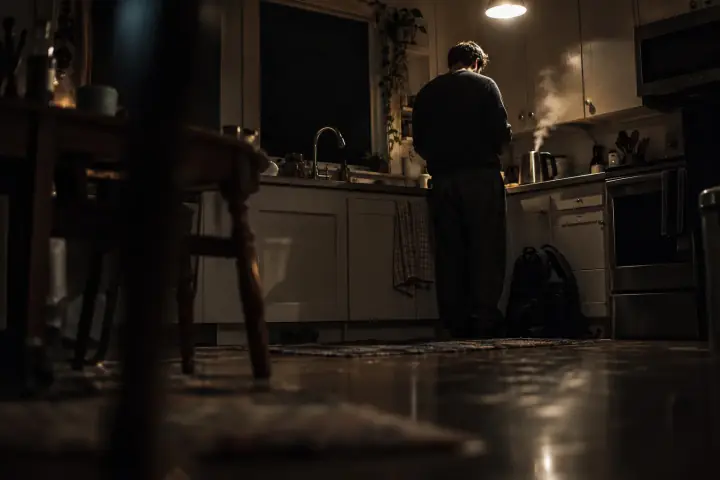
4:41 a.m. The kettle clicks off louder than any kettle has a right to. The window over the sink is still black, so the ceiling light is on, and the train leaves at 5:32.
It’s day four of the new schedule, and you feel oddly fine. A little smug, even.
That feeling is the least reliable reading you’ll take all morning. Getting up at 5 is the easy half. The half that decides whether it works happened last night, at whatever time you turned the light off.
What time should you go to bed to wake up at 5am?
Asleep by 10 p.m., not just in bed by then. The CDC puts adults 18 to 60 at "7 or more hours" a night, and seven hours back from 5:00 is 10:00. Teens 13 to 17 need "8–10 hours," which pulls their deadline to 9 p.m. or earlier.
Almost nobody falls asleep the second the lamp goes off, so build in a cushion. Ours is 15 to 20 minutes, a Risly rule of thumb rather than a measurement.
| Alarm | Adults: asleep by | Adults: lights out (our 20-min cushion) | Teens 13–17: asleep by |
|---|---|---|---|
| 4:00 a.m. | 9:00 p.m. | About 8:40 p.m. | 6:00 to 8:00 p.m. |
| 5:00 a.m. | 10:00 p.m. | About 9:40 p.m. | 7:00 to 9:00 p.m. |
| 6:00 a.m. | 11:00 p.m. | About 10:40 p.m. | 8:00 to 10:00 p.m. |
Look at the 4 a.m. row for a teenager: asleep by 8 at the latest, 6 at best. No 16-year-old keeps that, so don’t set their alarm for 4.
Count back from your alarm
Put in 5:00, or whatever your alarm says, and see the bedtimes that give you a full night first.
To wake up at 07:00, go to bed at:
- 21:457.5–9 hours
- 23:157.5–9 hours
- 00:45
- 02:15
Fifteen minutes is the standard default, not a fact about you. Set it to what your nights actually look like and every time above moves with it.
Why the first week of waking up early feels fine
Because sleep debt doesn’t announce itself. In 2003, a University of Pennsylvania team had 48 healthy adults, aged 21 to 38, live in the lab (Sleep). For two weeks, some got 8 hours in bed a night, some 6, some 4; a separate group went three nights with none. "All other sleep was prohibited."
Six hours or less in bed a night produced deficits on performance tests equal to up to two nights with no sleep at all. And the volunteers didn’t know. The researchers wrote that they were "largely unaware of these increasing cognitive deficits": their sleepiness ratings barely told the 6-hour group from the 4-hour one.
Now back to the kitchen at 4:41. Set a 4:30 alarm without touching a 10:30 bedtime and you get six hours in bed, the exact dose from that lab. Feeling fine on day four is what the 6-hour group felt too. If that’s been your week, the sleep debt calculator adds up what it cost.
How to wake up early: move the bedtime first
Move bedtime and alarm together, 15 to 20 minutes a night, and let the bedtime lead. That’s the step the American Academy of Sleep Medicine gives for the spring clock change: "Shift your bedtime 15 to 20 minutes earlier each night for a few nights."
From a 7:00 alarm to 5:00 is two hours: eight 15-minute steps, so about eight nights. The AASM wrote "a few nights" for one clock change; stretching it to eight is our extrapolation. If a night goes badly, repeat that step instead of skipping ahead.
The calendar hands you a head start. Clocks fall back on November 1, so for the few days your body takes to catch up, 5:00 will feel like 6:00 used to. Spend them locking in the 10 p.m. bedtime, not sleeping later.
Why moving your alarm isn’t enough
Your alarm moves your morning. Light moves your body clock. The cleanest test is from Chicago in 2003: Eastman’s team at Rush had 28 young adults rehearse an eastward flight to Europe without leaving town (Journal of Biological Rhythms). Every group moved its sleep an hour earlier a day for three days. Only the light after waking changed: dim, light boxes flicking on and off, or light boxes the whole time.
Same wake times, three results. The internal clock moved 0.6 hours in dim light, 1.5 with the on-off boxes and 2.1 with steady bright light. Get up into ordinary dim room light and your body follows about a fifth of the move.
That was jet-lag rehearsal, not 5 a.m. risers, but it’s the same lever, and at 5:00 the sky won’t pull it for you: in New York the sun never rises before 5:24, even in June. So every ceiling light goes on for the first hour or two, our rule of thumb (the study’s boxes were brighter still, over 3,000 lux), and at night you do the AASM’s other half: "dim the lights." The first stretch will still feel thick. That’s sleep inertia, not proof the plan failed.
Does a harder alarm get you up at 5am?
It gets you out of bed. It can’t hand you the sleep. One r/getdisciplined thread is titled, in the line Google shows: "bro how do u guys actually wake up at 4am? i literally solve math alarms." The math was never the hard part. The bedtime was.
That’s Risly’s honest limit too. Its alarm stops when you finish a mission, like scanning an object in another room, and snooze is off by default and only appears after the mission. That ends the 5:00 bargaining. It does nothing for an 11:30 bedtime, and it runs on iOS 26 and later only. If the new alarm keeps turning into three snoozes anyway, here’s how to break that loop.
How to wake up at 4am or 6am
Same math, different hour. A 6 a.m. alarm means asleep by 11, which from a 7:00 alarm is four 15-minute steps, under a week. A 4 a.m. alarm means asleep by 9, and the hard part there is social: you leave dinners early, every time.
Shift workers don’t get small steps. A night nurse on r/Nightshift works "three 12-hour nights" and then flips back to days on the days off. For a flip that fast, the Chicago lever is the one to pull: bright light at the start of the new morning.
Made-up example, not a study. Camila, 19, a sophomore in Austin, has a 7:00 lab and a 5:30 alarm "to study first." It’s 10:58 p.m., her laptop is at 14% and her roommate is still gaming behind the curtain. At 19 she’s in the CDC’s adult row, so 5:30 needed her asleep by 10:30. Laptop shut now, alarm moved to 6:15: seven hours if she’s asleep by 11:15.
What to do tonight
- Pick a bedtime, not an alarm. Take your target wake time, subtract 7 hours (8 to 10 for a teen), then subtract our 15-to-20-minute cushion.
- Take the first step tonight. Alarm at 7:00? Set it for 6:45, and turn the light off 15 minutes earlier than last night.
- Decide which switch you hit first tomorrow, and make it the brightest room you have. After dinner, dim the lamps.
- Don’t trust day four. Feeling fine isn’t proof you’re rested. A bedtime that keeps you at 7 hours or more is.
Hold it for a few weeks and you may start waking just before the alarm, at 4:52, with the kitchen still dark. Reach for the light switch first.
Waking up at 5am: common questions
Is 6 hours of sleep enough if I wake up at 5am?
Not for most adults: the CDC says 7 or more. In a 2003 University of Pennsylvania lab study, adults kept to 6 hours or less in bed for two weeks ended up performing as if they’d lost up to two nights of sleep, and barely noticed.
How long does it take to get used to waking up at 5am?
No study gives a number. In 15-to-20-minute nightly steps, 7:00 to 5:00 takes about eight nights, our pacing rather than a tested one. Judge it by your bedtime, not by how you feel after a few days.
What time should a teenager go to bed to wake up at 5am?
Asleep between 7 and 9 p.m.: the CDC puts teens 13 to 17 at 8 to 10 hours. Lights out 15 to 20 minutes before that, our rule of thumb for falling asleep.
Sources
- timeanddate.com. Sunrise and sunset times in New York, June 2026
- Centers for Disease Control and Prevention. About sleep (recommended hours by age)
- Van Dongen, Maislin, Mullington & Dinges (2003). The cumulative cost of additional wakefulness: dose-response effects on neurobehavioral functions and sleep physiology from chronic sleep restriction and total sleep deprivation. Sleep
- American Academy of Sleep Medicine. Daylight saving time (sleepeducation.org)
- Burgess, Crowley, Gazda, Fogg & Eastman (2003). Preflight adjustment to eastward travel: 3 days of advancing sleep with and without morning bright light. Journal of Biological Rhythms
Keep reading




Ready when you are
Choose your next wake-up mission.