
Why do I wake up before my alarm? (And should you get up?)
Your body clock learns your wake time and starts preparing an hour ahead. Our rule of thumb: within 30 minutes of the alarm, get up or doze. Don’t clock-watch.

The short answer
You wake up before your alarm because your body clock learns when you get up and starts preparing about an hour ahead: in a 1999 Nature study of 15 sleepers, the hormone ACTH began rising an hour before the wake time they’d been told to expect. A few minutes early and rested is that clock working. Hours early and exhausted, most mornings, is a different problem.
It’s 6:52. The phone is face down on the nightstand, the room has gone from black to gray, and your eyes are open for no reason you can name. The alarm is set for 7:00. Eight minutes.
Then the math starts. Is eight minutes worth closing your eyes for? Will you feel worse if you do? The line Google shows from one r/Anxiety thread sums it up: "My least favorite game is trying to decide whether I’m up 20 minutes before my alarm."
Waking at 6:52 isn’t a glitch. Your body set its own alarm.
Why do I wake up right before my alarm?
Because you told it to, the night before. The best evidence comes from a lab in Lübeck, Germany. In 1999, Jan Born’s team had 15 young volunteers sleep in the lab while their blood was sampled through the night (Nature). Told in the evening they’d be woken at six, their blood started changing around five, while they were still asleep: the hormone ACTH rose "one hour before waking."
You’ll read that a "cortisol spike" wakes you. Wrong moment: the cortisol awakening response is defined as the rise in the first 30–45 minutes after waking (Psychoneuroendocrinology, 2016). What climbs before is ACTH, upstream of it.
Is waking up before your alarm a good sign?
Usually, yes. When a Luther College team in Decorah, Iowa, phoned 269 adults, over half said they never use an alarm or "always awaken before it." Another 24% said sometimes (Sleep, 1997).
They then put wrist monitors on 15 self-described self-wakers for three nights in their own beds. Five woke within 10 minutes of their target every night, and five more on two nights out of three. Back in the phone survey, the knack went with a steady amount of sleep, not a steady wake time.
So 6:52 is usually good news. It stops being a gift when you spend it arguing with yourself. (If you wake up foggy rather than early, that’s sleep inertia, a different story.)
Should you get up or go back to sleep?
Decide in the first minute. Within half an hour of the alarm (Risly’s rule of thumb, not a research finding), neither choice hurts you. Watching the clock does.
A short doze is close to a snooze, and the research on snoozing is kinder than its reputation. Getting up costs a few minutes your body was already wrapping up.
The middle option loses. The AASM tells people who can’t sleep to "avoid checking the clock," and to get out of bed after "about 15 to 20 minutes" of frustration.
| How early you wake (Risly’s rule of thumb) | Do this | Why |
|---|---|---|
| Under 30 min, clear-headed | Get up and switch the alarm off | Your body already did the waking |
| Under 30 min, drowsy | Phone face down, eyes shut, let the alarm ring | A short doze costs little |
| 30 to 60 min | Stay in the dark. Still awake after 15–20 min? Get up | The AASM’s advice for a sleepless stretch |
| Hours early, most mornings | Read the next two sections | This isn’t the clock working |
If you get up, turn the alarm off
A made-up but typical case, not a study. Joel, 34, a pharmacist in Columbus, opens his eyes at 6:41 with a 7:00 alarm. He feels awake, gets up, and switches the alarm off so it doesn’t ring at an empty bed. One catch, in our reading of the iPhone Clock app: that toggle stays off until he flips it back on, so he does it at breakfast. The mornings he stays put "for five more minutes," he’s still there at 7:00.
If your doze keeps turning into three snoozes, that’s what Risly was built for. The ringing screen has no snooze button: the alarm stops when you finish a mission, like scanning an object in another room. Snooze is off by default, and even if you turn it on, it only appears after the mission. It’s iOS 26 and later only, and blunt on purpose. If you want to be woken gently, a sunrise lamp suits you better.
Why do I wake up before my alarm and still feel tired?
Because what woke you probably wasn’t a body clock finishing its work. Something cut the night short.
Dread does it. Anyone who has woken at 4:50 before a 7 a.m. flight, or before a hard conversation at work, knows the feeling: the alarm hasn’t rung yet and you’re already braced for it.
So does a drink. The nightcap that helped you drop off is often what wakes you at 5.
And light. A blind that leaks at sunrise can beat your alarm every single day.
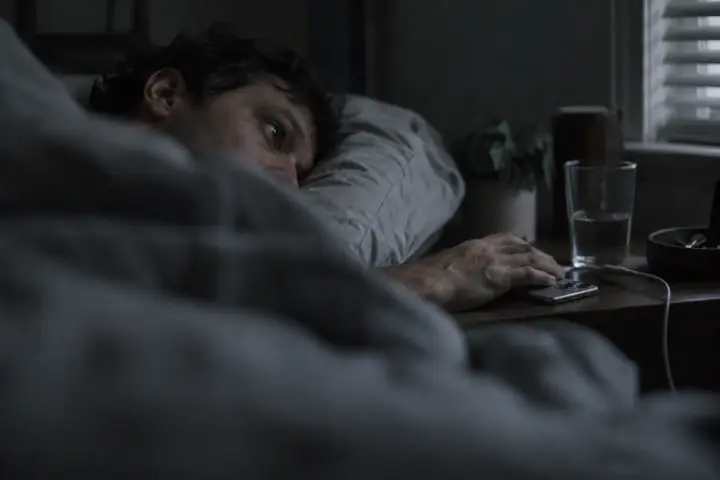
When waking up early is worth a doctor’s visit
When it’s the pattern, not the exception: you wake hours early, can’t get back to sleep, and drag through the day. "Waking too early in the morning" is on the NIMH’s list of depression symptoms, and a diagnosis looks for symptoms "most of the day, nearly every day, for at least 2 weeks." If that sounds like your last few weeks, book an appointment. A better alarm won’t fix it.
Two lookalikes. If your problem is the reverse, an alarm that doesn’t wake you at all, see sleeping through your alarm. And after the clocks fall back on November 1, expect to wake an hour "before" your alarm for about a week. That’s your clock catching up, not your mood.
What to do tonight
- Pick your rule now, while you’re thinking straight. Ours: within 30 minutes of the alarm, you either get up or go face down and doze. No third option.
- Phone face down, ideally out of reach, so checking the time takes effort.
- Keep the amount of sleep steady. In the Iowa survey, waking before the alarm went with sleeping a consistent amount, not with a fixed wake time.
- Skip the late drink if 5 a.m. wake-ups are your pattern.
- Fix the blind if dawn or a streetlight reaches your pillow.
Count back from your alarm
Enter your alarm time to see bedtimes that give you a full night first.
To wake up at 07:00, go to bed at:
- 21:457.5–9 hours
- 23:157.5–9 hours
- 00:45
- 02:15
Fifteen minutes is the standard default, not a fact about you. Set it to what your nights actually look like and every time above moves with it.
Then tomorrow at 6:52, there’s nothing to decide. You did that last night. If the doze keeps winning, how to stop hitting snooze picks up from here.
Waking up before your alarm: common questions
Is it bad to go back to sleep 10 minutes before your alarm?
No. A short doze near morning costs little, much like a single snooze. What hurts is lying awake checking the clock. Our rule of thumb, not a study finding: within 30 minutes of the alarm, doze or get up.
Why do I wake up at the same time every morning without an alarm?
Your body clock has learned your schedule. In a 1997 phone survey of 269 US adults, the ability to wake before the alarm went with a consistent amount of nightly sleep, not with a consistent wake-up time.
Is waking up before your alarm a sign of depression?
Usually not. A few minutes early and refreshed is normal. Waking too early in the morning is on the NIMH’s list of depression symptoms, though, so if it happens nearly every day for two weeks or more, see a doctor.
Sources
- Born et al. (1999). Timing the end of nocturnal sleep. Nature
- Stalder et al. (2016). Assessment of the cortisol awakening response: Expert consensus guidelines. Psychoneuroendocrinology
- Moorcroft, Kayser & Griggs (1997). Subjective and objective confirmation of the ability to self-awaken at a self-predetermined time without using external means. Sleep
- American Academy of Sleep Medicine. Improve your sleep in five simple steps (sleepeducation.org)
- National Institute of Mental Health. Depression
Keep reading




Ready when you are
Choose your next wake-up mission.